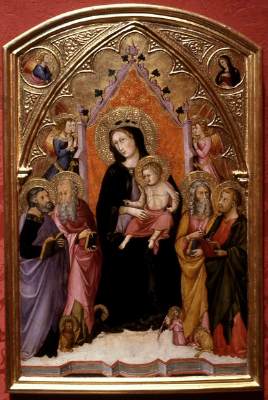
The sacredness of Sacred art
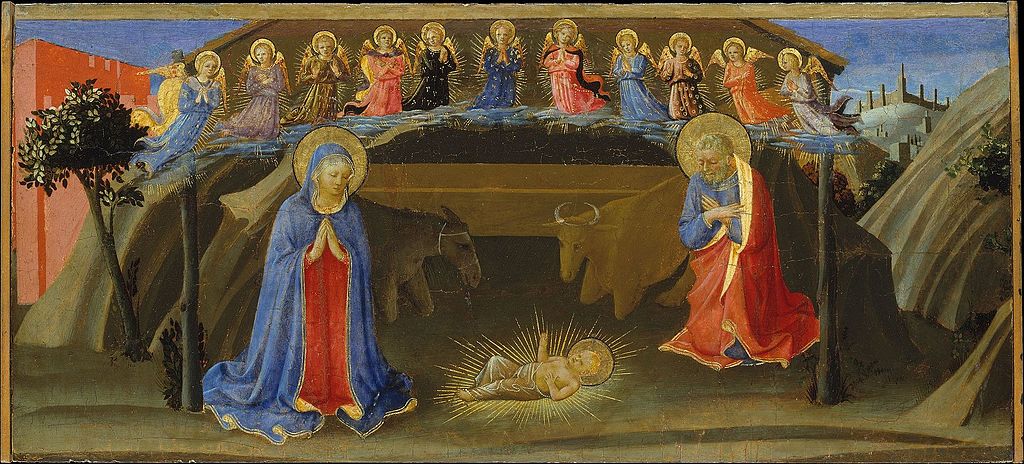
On this glorious feast of Mary, Mother of God, the Christmas octave is now complete but the Christmas season continues on. In Advent and Christmas, we have journeyed with the Holy Family. It is opportunity to walk their path with them in a very personal way. Jesus praying in Mary’s womb, physically secluded as if in a tabernacle, still present to all who are around Him. Joseph ever-ready to assist Mary when needed. All called to Bethlehem not as part of a Jewish ritual or annual obligation but, rather, unexpectedly called due to Cesear Agustus’ desire to number his kingdom. Give to Cesear what is Cesear’s and give to God what is God’s (Mark 12:17). Thirty years later when Jesus uttered these words, Mary’s understanding of them would be profoundly different than the other hearers.
Just as aloneness and loneliness are two very different things, so too solitude vs. isolation. With many of the descendants of King David in the Roman empire converging upon Bethlehem at the same time, perhaps Joseph and Mary didn’t expect to find reasonable quarters in which to stay. Jesus, on the other hand, had already chosen the aloneness and solitude of the cave. Just as we find in adoration of the Blessed Sacrament, this silence with only a few people at a time coming to visit Him is too precious to be diluted with the noise and distractions of the world outside.
Then He is born. This moment is one of the most important in all of salvation history.
Hear, O heavens, and listen, O earth,
for the Lord speaks:
Sons have I raised and reared,
but they have rebelled against me!
An ox knows its owner,
and an ass, its master’s manger;
But Israel does not know,
my people has not understood. (Isaiah 1:2-3)
Our modern day nativity scenes hail from that created by St. Francis of Assisi in 1223. The saint didn’t create from his own imagination, adding whimsical elements or creatures whose presence would have meaning to him. Rather, he re-presented the birth of Jesus as given to us in the bible. And it was very simple: the holy family, an ox and an ass, the feeding trough and hay. In ancient Israel, oxen were sacrificed as they were considered a clean animal; asses were considered unclean. Now the Lamb of God, who is the new unblemished sacrificial lamb, redeems both the clean and unclean in His sacrifice.
“The Mother of God is never separated from the Divine Child; one of the oldest paintings of the catacombs, painted under the eyes of the pupils of the Apostles and found in the cemetery of Priscilla, represents the Virgin holding the Child on her lap, while the Prophet Isaias, who stands before her, points to the star above the head of the Mother and Child.” (Catholic Encyclopedia, Roman Catacombs)
Since the time of the apostles, sacred art was created to represent the Sacred Ones. Symbolism such as animals had precise meaning. The fish from the Greek word Ichthys represented Christians and the word itself adopted as an acronym to stand for “Jesus Christ, the Son of God, the Savior”. The lamb who is with the Good Shepherd represents the Christian soul in earthly life; the dove, its release by death to eternal life.
Where there are no oxen, the crib is empty: but where there is much corn, there the strength of the ox is manifest. (Proverbs 14:4)
Throughout the centuries, artists have drawn the Sacred Ones in their own style just as the Gospel writers wrote in their own voice. Hence, we see for instance a blond haired, blue eyed child Jesus with curly locks from European artists, or icons with a long-faced dark skinned Jesus and Mary from northern Africa. Although the style may change, the artists maintain devotion to the scriptures their art represents. They do not add their own innovations and inventions. We do not see, for example, ostriches or camels in the cave with Jesus in the nativity scene despite both animals being prevalent in Palestine at the time. The animals represented at Jesus’ birth are specific to the prophecies He fulfilled as the Messiah. Also, as the ox represents the Jews and the ass, the Gentiles, it is seen as symbolic of the whole world receiving the manifestation of their God.
Sacred art, then, is the bible in images.
“The very animals, therefore, the ox and the ass, having Him in their midst, incessantly adored Him. Then was fulfilled that which was said by Habakkuk the prophet saying: “Between two animals you are made manifest” (Hab. 3:2) (Ascension Press)
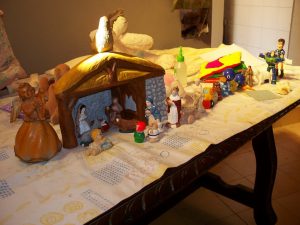
In our contemporary society, we have grown distant from the notion of the sacred. Many people today do not even know what a halo is whereas just one or two generations back, halos were demarcations of the Sacred Person in art and commonly seen in society. With regard to the nativity of Jesus, today we see all sorts of inventions that represent the quirks and ideologies of the maker or owner. Today the nativity set has too often become a toy for children and adults rather than a depiction of one of the most important moments in salvation history. It is meant to be an object of devotion which stimulates us to raise our hearts in awe of God, for that is the purpose of all sacred art. Instead, it becomes a field of imaginative play and silliness. Or worse, an expression of secular values or a syncretization with pagan belief systems. Rather than a deep movement of the heart towards its God, it is an attempt to conform God to one’s own liking.
As the Church founded by Jesus Himself, we have a duty to keep the sacred in Sacred art. As the bride of Christ, we have opportunity to share with the world the beauty of the Sacred and our ancient heritage. Let’s renew our own love, awe, and respect for Sacred art and bring that passion into our life world.
“Sacred art takes one out of the finite and into the infinite. … [it] can allow one to “thirst for the transcendent.” (Jacob Benda)
Ad Majorem Dei Gloriam 😊
(Images: nativity by Zanobi Strozzi, circa 1433-34; child’s nativity set by Bobjgalindo circa 2008, both public domain from Wikimedia)
Thank you for caring and sharing appropriately...
Consecrated to the Sacred Heart of Jesus through the Immaculate Heart of Mary. Except where noted, all design, writing and images ©2024 by Debra Black and TheFaceofGraceProject.com. All Rights Reserved. No part of this website may be reproduced, distributed or transmitted in any form or by any means, including downloading, photocopying, recording, or other electronic or mechanical methods, without the prior written permission of the publisher, except in the case of brief quotations embodied in critical reviews and certain other noncommercial uses permitted by copyright law. For permission or to report violations please email: thefaceofgraceproject@gmail.com