The visit of kings
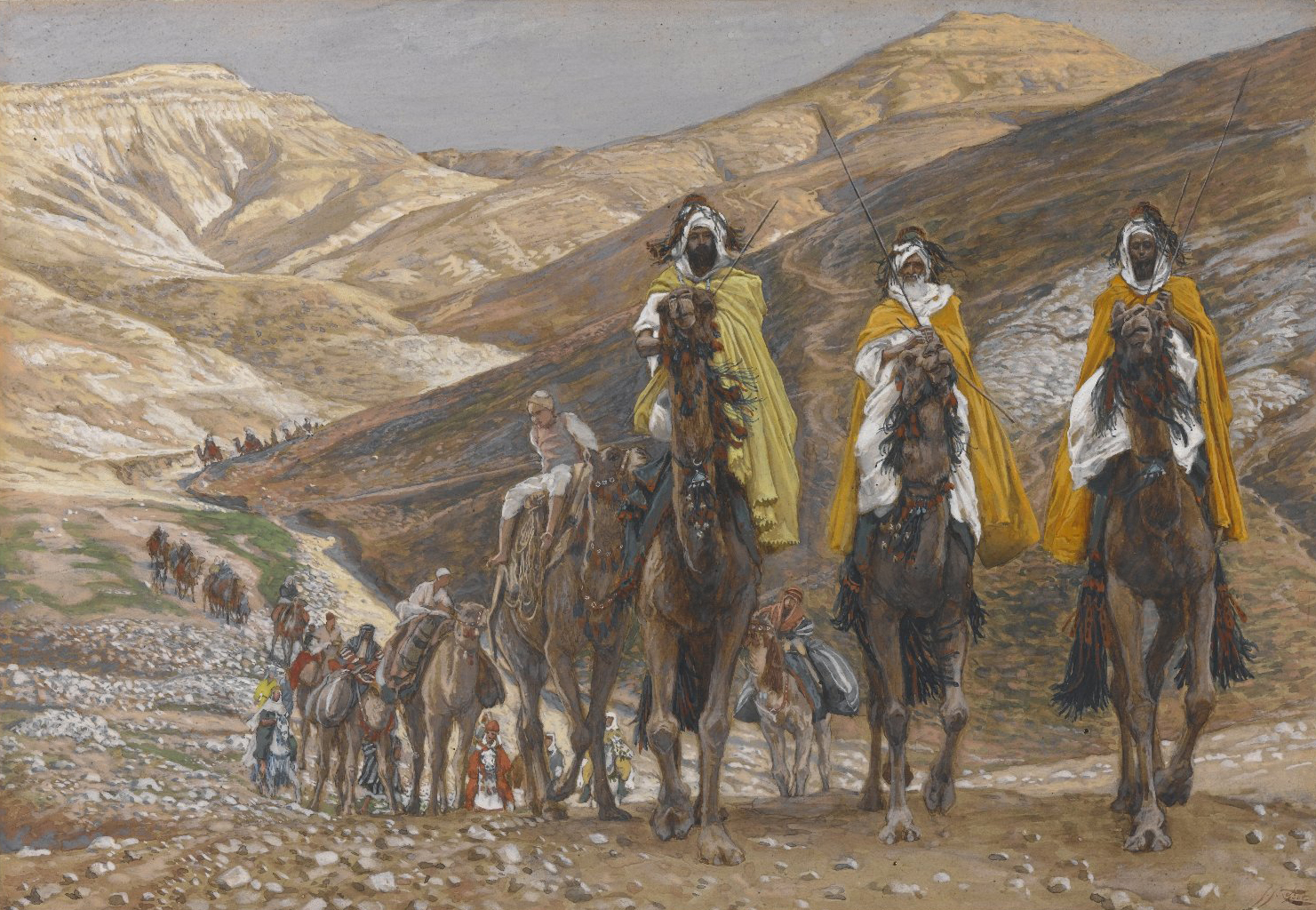
On this holy day of the Epiphany, we celebrate the Magi’s arrival to pay homage to the newborn king. Two thousand years later, these men remain somewhat of a mystery. Yet what we do know is sufficient for prayerful meditation.
Matthew’s gospel chapter 2 begins with:
When Jesus was born in Bethlehem of Judea, in the days of King Herod, behold, magi from the east arrived in Jerusalem…(v. 1)
They came from the east. Some contemporary scholars pitch the idea that these men were of Jewish descent from those Israelites who were exiled in Babylon in the 6th century BC. However, most scholars continue to consider them Persian gentiles. They were the priestly caste of Persians.
How far was “East”? How far did they need to travel? According to the Catholic Encyclopedia, “of between 1000 and 1200 miles. Such a distance may have taken any time between three and twelve months by camel.” Like any travelers, they had risked marauders and robbers on the road, injury and illness.
…saying, “Where is the newborn king of the Jews? (v. 2)
They were looking for a newborn. Why would they be interested in a new king being born? Generally, a new king will bring great favor or be an enemy and pose a threat. In this situation, the new king is a Jew and the Magi are not. But they are not of a military caste, and if one thought a new king might be an enemy, they wouldn’t go visit him. They believed there to be benefit to this king being born, benefit to the whole world, even non-Jews. And they must have assumed the Jews would welcome this newborn king too, for they went to visit Herod the reigning king—certainly a reigning king doesn’t want to hear of the birth of a competitor for his throne! No, the Magi must have known this wasn’t an earthly king, and assumed the earthly king would welcome the long-awaited Messiah.
…We saw his star at its rising and have come to do him homage.”
Numbers 24:17 gives the prophecy that, “A star shall advance from Jacob”. Had they been taught this prophecy? Had they been waiting, watching the stars until the moment it arose? Of all the stars in the sky every night, it took just one to draw them to Jesus.
Their desire to greet this newborn king was such that they took off toward the general direction of where the star had arose. No route pre-planned, for the final destination wasn’t known. They embarked on a journey of unknown length and time. In our modern times, we know the destination we are traveling too, how long the flight or road trip will take, and what we will need to bring with us. All they knew was the present location and the final achievement to be had—being with the King. In a way this models our pilgrimage on earth. We know the present and our final destination—Heaven, our King. We can gauge somewhat the provisions and needs to be met along the way, but no one can map out their pilgrimage precisely.
When King Herod heard this, he was greatly troubled, and all Jerusalem with him. Assembling all the chief priests and the scribes of the people, he inquired of them where the Messiah was to be born. They said to him, “In Bethlehem of Judea, for thus it has been written through the prophet:
‘And you, Bethlehem, land of Judah,
are by no means least among the rulers of Judah;
since from you shall come a ruler,
who is to shepherd my people Israel.’”
Then Herod called the magi secretly and ascertained from them the time of the star’s appearance. He sent them to Bethlehem and said, “Go and search diligently for the child. When you have found him, bring me word, that I too may go and do him homage.”
After their audience with the king they set out. (v. 3-9)
These three Magi had an audience with the king. Strangers to him. Not just anyone can walk into a palace and request an audience. These Magi may have had a letter of introduction and request for safe passing from their own king, or maybe they were kings, or perhaps their priestly vestments with cultural adornments spoke for them of their rank. Nonetheless, they were men of sufficient power that Herod didn’t send them away nor were they afraid of him (his ruthless ways including killing his own wife and sons).
And behold, the star that they had seen at its rising preceded them, until it came and stopped over the place where the child was. They were overjoyed at seeing the star… (v. 9-10)
They leave Jerusalem heading towards Bethlehem, not knowing the house of this new King but knowing at least the village. The current king, Herod, didn’t seem to know either. Their journey from Persia began by heading generally towards the land of the Jews, Jerusalem, and now it narrows to the village of Bethlehem. Then suddenly the star reappears and guides them to the precise place of this new King, the one that the world awaited. To say they were overjoyed must be an understatement! After a year of traveling by camel, they now are confident the King is close by. As they follow the star which preceded them, they certainly must have understood this was the God of the Hebrews guiding them.
…and on entering the house they saw the child with Mary his mother. (v. 11)
The Hebrew word for mother used in this passage is that used to address a great lady, a queen. It is the same word used to address King Solomon’s mother, the queen. For the Magi, the boy child was the king so of course his mother was the queen.
They prostrated themselves and did him homage. Then they opened their treasures and offered him gifts of gold, frankincense, and myrrh. And having been warned in a dream not to return to Herod, they departed for their country by another way. (v. 11-12)
Royals do not prostrate themselves on the ground before other royals and pay homage. Yet these men did. They had power and wealth but also had humility. And they had obedience and loyalty to this King, following the instruction given them in their dream to not return to Herod.
There is much to learn from the Magi. Perseverance in staying the course given us by God. Following Him despite the uncertainty of our pilgrimage, that great in-between separating us from Heaven. Humility, obedience, loyalty, waiting. These are all gifts that we too can give to our King.
“For what could they have to say, who did not receive Christ after so many prophets, when they saw that wise men, at the sight of a single star, had received this same, and had worshipped Him who was made manifest.” (St. John Chrysostom)
Ad Majorem Dei Gloriam 😊
(Image by James Tissot, Public domain, via Wikimedia Commons)
Thank you for caring and sharing appropriately...
Consecrated to the Sacred Heart of Jesus through the Immaculate Heart of Mary. Except where noted, all design, writing and images ©2024 by Debra Black and TheFaceofGraceProject.com. All Rights Reserved. No part of this website may be reproduced, distributed or transmitted in any form or by any means, including downloading, photocopying, recording, or other electronic or mechanical methods, without the prior written permission of the publisher, except in the case of brief quotations embodied in critical reviews and certain other noncommercial uses permitted by copyright law. For permission or to report violations please email: thefaceofgraceproject@gmail.com