Live Catholic! Virtue, flourishing, and discernment of spirits
“If a man begins to be led by the Spirit of God, then the mightier power of love struggles against the power of the flesh.” … “passion decreases as love increases until love comes at last to that fullness which cannot be surpassed” (St. Augustine, Enchiridion On Faith, Hope, and Love)
As Catholics, we’ve heard of ‘virtues’ but typically know little about them! Yet these are an extremely important part of God’s plan for us to flourish here on earth and eventually spend eternity with Him.
These five words of truth can shift your paradigm and change your life: virtues are love in action. These aren’t ways to avoid being a bad person. These are an important way that we love God and the people He has put in our life. Virtues not only make our acts good, these make us good. We grow in His likeness. Too often we distance ourselves from the saints because we think we could never be like them. That’s the lie of the enemy because its premise is that God made you incapable of love! The truth is that God made you for love. Through the spiritual exercise of practicing virtues, His grace transforms you so you can more fully receive and give love. And contrary to the world’s thinking, that’s flourishing.
Our actions transform us into the nature of the act: morally good acts make us good, morally bad acts make us bad. With repetition these become habits that mold the disposition in the soul’s power. Moral virtues provide a readiness to certain types of actions that perfect us; these become easier and easier over time. Immoral habits lead to its disorder and dysfunction. As ensouled bodies, our brains develop pathways as the acts are repeated, which makes it easier to repeat the act again. When we are trying to overcome a vice or sin, we are fighting these pathways in our brain. That’s why it is so hard to change! However, God’s grace gives us ability to overpower those pathways and create new ‘roads’ in our brains. With repetition, the moral virtues then become our way of being. As prudence, right reason, and resistance to temptation become our default behaviors, acting against the virtues actually becomes difficult and the more excellent choice is easier.
But developing those excellent habits requires effort on our part to cooperate with God’s grace while denying our unholy thoughts and behaviors. St. Ignatius of Loyola’s first set of rules on the discernment of spirits teaches us how the saints combatted their own weaknesses to grow in holiness. By self-monitoring our thoughts, psychological and emotional feelings, and our physical state, we can identify downward movements of the heart away from God. We call upon His grace for help, reflect upon what we’re feeling and when it began, determine if it’s leading us away from God, and take action to reject it. Because we cannot best use prudential reasoning when emotions are disordered, this ‘spiritual exercise’ enables us to then resist temptation and desolation so as to make the prudent choice and act with virtue. The virtues are the means of combatting the enemy. In that sense, discernment of spirits is fundamental to living virtuously.
St. Ignatius also gives us many other rules, which are guidances for living virtuously. The Rules for eating teach us to plan ahead now (after a meal) for what we will eat the next day. Planning while we are full, we’ll be less likely to avoid overeating or eat unhealthy when hungry. Planning ahead aids us to live in moderation. These rules are the habit for any activities in life that might tempt us to overuse or, conversely, to sloth and avoidance. Use of internet and screen time, news, media and entertainment, studying and learning, exercise, fellowship with others, spiritual devotions…all are good in themselves. But when overused or misused, these can be harmful to us.
Developing the virtue of moderation and temperance in our exterior life can then affect our interior life. The self-honesty required for self-denial and self-monitoring prepares us for honesty with God in our conversations with Him (prayer). In rule 10 of the discernment of spirits, St. Ignatius of Loyola teaches us that, when in spiritual consolation, to prepare for future desolation. It is in this time of accepting and returning God’s love to Him that, with Him, we can ask for enlightenment on best ways to prepare ourself. Our truth list and penance list (from rule 6) can be reviewed and enhanced to more specifically battle the techniques the enemy uses against us. So pre-planning for moderation in our areas of weakness (such as food or screen time) strengthens us to pre-plan for desolation when in consolation.
Here is an example of how the enemy tries to undermine our growth in virtue:
Let’s say God has given you the natural strength of healthy eating and you are not easily tempted by poor choices in this way. Conversely, your natural weakness has been sloth towards exercise and fitness. You may start exercising, join a gym, take up walking regularly with a neighbor, only to eventually drift away.
Rather than tempting you with an action (e.g. buying donuts), the enemy will tempt you against acting (put off exercising). He personalizes his work to your specific weaknesses and vices.
Temptation and desolation are the enemy’s one-two punch. He hits you with a jab—the temptation—and then the knock-out punch—the desolation. His voice goes something like this:
He tempts you to sloth: “Don’t do your exercises right now as planned. Do them later.” (or) “You need to rest; you can do them tomorrow.” And you accept his advice—the jab.
He claims your identity and the universal negative: “You should have known you’d give in and not be consistent with your exercises. You’ve never been able to exercise regularly. Why did you think you could now? It’s always been this way and always will be.” The desolation sets in. He doesn’t even need to say the words. His suggestions have led you to the natural conclusion: I’m a loser. I always have been and always will be. The knock-out punch.
He escalates this from the non-spiritual to the spiritual: “You can make better use of your time. Pray ten novenas instead” (overuse/misuse of the good). (or) “If you can’t do something as simple as 20 minutes of exercise each day, what makes you think you can pray for 15 minutes each day?” (spiritual sloth) The non-spiritual desolation has given the space for the enemy to now endanger your relationship with God. His tool is using against you that which is good and appealing to any faithful Christian: your faith practices.
However, that same space in which the enemy works is also the space which grace will work and will do so much more powerfully. But you must invite God into the desolation. In doing so, this brings the non-spiritual to the spiritual in its truth, that of God’s power, providence, and personal love for you. The enemy pushes, pulls and scares you into desolation. God invites you into grace. By embracing grace and cooperating with His Spirit, you will have the fortitude and steadfastness to not only reject the desolation but to resist temptation in the future. The trial is a spiritual exercise. The virtues built are needed for our flourishing. As these virtues become our habit, our soul and body are habituated to receive and give love. In other words, we begin to live our human nature more fully, living as we were created to be: flourishing.
And if I did stick with the 20 minutes of exercises each day, my ensouled body supports and responds to my soul’s desire and direction to act with virtue. It responds readily and easily to that which is naturally good, supporting my soul’s higher faculties (intellect and will) to respond to that which is spiritually good: truth and love.
Knowing it’s a trial and that God has given us sufficient grace to endure it (rule 7), and knowing it has purpose which brings hope so we may patiently work against it (rule 8), then reviewing it to understand its purpose (rule 9) grow us in humility and, from that, perseverance. When this spiritual awareness and subsequent discernment of spirits is engaged, discernment becomes a lifestyle. Interior freedom! This is the way of growing in virtue, and living virtuously is how we flourish. This is how we were originally meant to be before the fall of Adam and Eve. Virtues are what is truly natural to us. The spiritual exercise of working through the desolation with God builds relationship with Him, which is the ultimate goal and blessing.
All of this is under God’s providence. This underlying belief in and surrender to God’s providence produces the trust needed. The saints knew this. The more they and we come to know God, the more we understand and value His power and magnanimity.
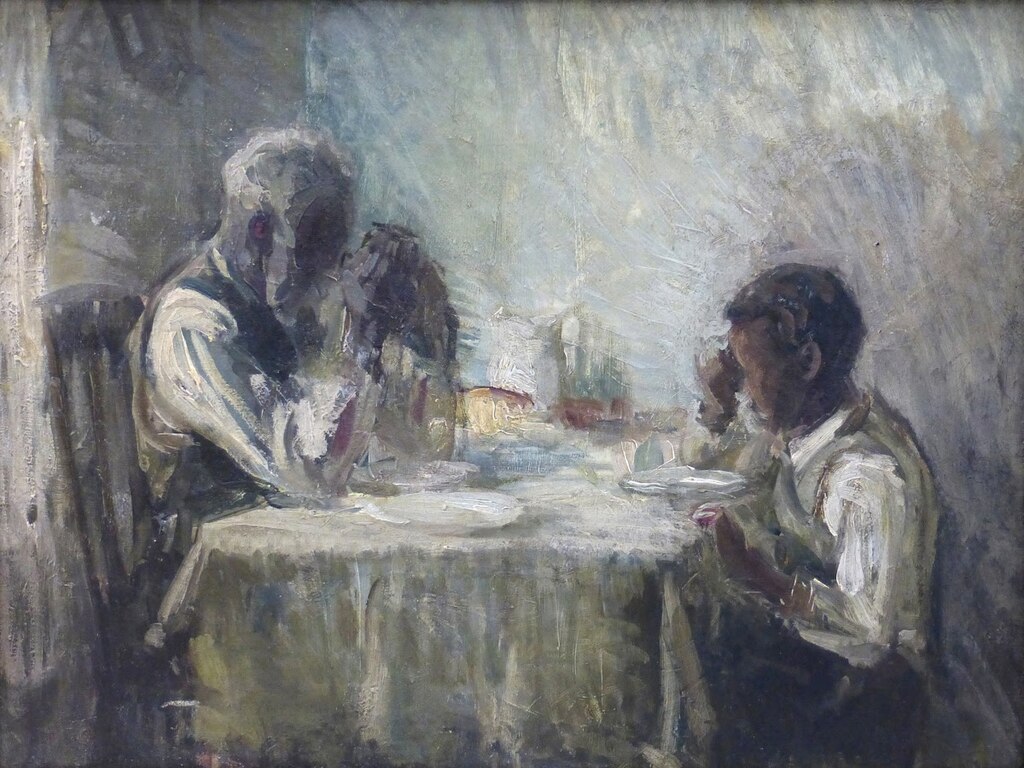
In the above painting, the old man and young boy are giving thanks to God despite their plates being empty. For us, Thanksgiving and Advent are around the corner. Both are seasons for growing in love of God, family, friends, and coworkers. Both also bring opportunity for excess; the misuse of many good things God has given us for this season. Anticipate the opportunities for excess and plan ahead now to live this Holiday season differently. Turn it into an opportunity to flourish. Take on an attitude of gratitude and Live Catholic.
Ad Majorem Dei Gloriam. 😊
(Image by Henry Ossawa Tanner, Public domain, via Wikimedia Commons)
Thank you for caring and sharing appropriately...
Consecrated to the Sacred Heart of Jesus through the Immaculate Heart of Mary. Except where noted, all design, writing and images ©2024 by Debra Black and TheFaceofGraceProject.com. All Rights Reserved. No part of this website may be reproduced, distributed or transmitted in any form or by any means, including downloading, photocopying, recording, or other electronic or mechanical methods, without the prior written permission of the publisher, except in the case of brief quotations embodied in critical reviews and certain other noncommercial uses permitted by copyright law. For permission or to report violations please email: thefaceofgraceproject@gmail.com